Wednesday, December 07, 2005

Lisa Ramaci, widow of Steven Vincent, interview

The more I think about it the more it pisses me off. I put this post together yesterday resporting on an interview that Fayrouz Hancock published at her blog from Dallas. It was powerful and compelling material from the hand of Stephen Vuincent's widow recounting the circumstances of his murder and affirming her love and concern for both him and his wounded translator who survived and as of this writing is still being held incommunicado by the authorities. That would be the same authorities that the US officially recognizes as legitimate in Iraq.

This is what remained of my post after deleting the key content at the request of both Fayrouz and Lisa Ramaci. (See the comments thread):


Fayrouz at Iraqi in America publishes a revealing interview worth reading. Stephen Vincent was a journalist killed within forty-eight hours after his story examining corruption in the Iraqi Security forces was published in the NY Times. I blogged about it at the time.

Because he had been working closely with a young woman who was his translator, the story immediately took on a tawdry spin which distracted from the content of his reportage. This interview puts that spin to rest and raises questions about why the authorities continue, nearly four and a half months later, to stonewall followups on his death and work.

[At Fayrouz' request I have deleted the interview comments. See comments below. I can understand how this is a very sensitive issue.]


Apparently the original post inspired a couple of trolls to leave ugly remarks in the comments thread so mean that Lisa Ramaci said she didn't want anything further to do with the discussion. The interview that originally appeared in Fayrouz' blog is now replaced with the following:

Well, forget that...It looks like the entire post has now disappeared. Before it was deleted there appeared an anguished letter from Lisa to Fayrouz pouring out her pain and frustration at the whole incident. I have the feeling that the anguish and grief of August came roiling back to her emotional surface and proved to be more wrenching than she could endure. This is a bleeding tragedy...compounding the murder of her husband that savage and irresponsible commentators, abusing the free and open world of the internet, would subject anyone to a level of verbal and emotional abuse that the victim decided to drop the matter rather than challenge the assault. It is the jouralistic equivalent of rape.

I hope Faurouz will forgive me, but I cannot let the matter drop as easily as that. What has happened to both her and her guest in the last twenty-four hours is savage and inexcusable. It does not rise to the level of the murder of Stephen Vincent, but in the aftermath of that event, now only four months past, it reveals an irresponsible emptiness of spirit on the part of a few individuals that I can only compare with the behavior of a drunk driver who cares nothing about the lives or safety of others on the road. Only yesterday I heard yet another story about a drunk driver who killed a young man on a motor cycle, taking him out in his twenties, leaving nothing but painful memories in his family that still bring his mother to tears with the memory, twenty-plus years later.

I did not read the comments left at her blog. All I recall of the now-gone message is something to the effect of I hope you are satisfied, lowlife scum, that by your mean-spirited comments you have destroyed in a moment the careful work of several weeks. There was some reference to what I referred to as the "tawdry spin" in my original post, so I have the feeling it derived from the unjustified, shooting-from-the hip reaction of Juan Cole less than a week after the report of Vincent's murder.


Was American journalist Steve Vincent killed in Basra as part of an honor killing? He was romantically involved with his Iraqi interpreter, who was shot 4 times. If her clan thought she was shaming them by appearing to be having an affair outside wedlock with an American male, they might well have decided to end it. In Mediterranean culture, a man's honor tends to be wrought up with his ability to protect his womenfolk from seduction by strange men. Where a woman of the family sleeps around, it brings enormous shame on her father, brothers and cousins, and it is not unknown for them to kill her. These sentiments and this sort of behavior tend to be rural and to hold among the uneducated, but are not unknown in urban areas. Vincent did not know anything serious about Middle Eastern culture and was aggressive about criticizing what he could see of it on the surface, and if he was behaving in the way the Telegraph article describes, he was acting in an extremely dangerous manner.

Apparently this snip, still part of the Informed Comment (Cole's blog) archives, is a cleaned up version of his original text which was even more suggestive of an affair between Stephen Vincent and his translator, a lewd and unfounded inferrence that his widow clarified and explained to be false. The more I read about this couple, the more impressed I am with the level of trust and fidelity they had for one another. Such faithfulness stands in sharp contrast with the breezy, morally bankrupt, criminally indifferent behavior of hundreds of men that I saw first-hand when I was in the Army.

Cole addressed the subject at some length August 24. He pointed out that he was not the source of the rumors about Vincent and his translator, and he remained aloof to the matter, preferring to come across as an erudite and (as the name of his blog so modestly boasts) well-informed academic more interested in other matters.

But there remains in the record a statement by Lisa Ramaci which appears in the Murdock Online archive. There is a good deal of give and take, and a raft of commentary that has now died down. Anyone who wants to dig around can spend a day or two sifting through it all. But this letter stands out as a fine example of what it means for a widow to stand up for her lately murdered husband. I am capturing it here in order to give her the last word.

Mr. Cole -

(I refuse to call you professor, because that would ennoble you. And please change the name of your blog to "Uninformed Comment", because that is precisely what the above paragraph is.)
I would like to refute this shameful post against a dead man who can no longer defend himself against your scurrilous accusations, a dead man who also happened to be my husband. Steven Vincent and I were together for 23 years, married for 13 of them, and I think I know him a wee bit better than you do.

For starters, Steven and Nour were not "romantically involved". If you knew anything at all about the Middle East, as you seem to think you do, then you would know that there is no physical way that he and she could have ever been alone together. Nour (who always made sure to get home before dark, so they were never together at night) could not go to his room; he could not go to her house; there was no hot-sheet motel for them to go to for a couple of hours. They met in public, they went about together in public, they parted in public. They were never alone. She would not let him touch her arm, pay her a compliment, buy her a banana on the street, hyper-aware of how such gestures might be interpreted by the misogynistic cretins who surrounded her daily. So for you brazenly claim that she was "sleeping around," when there is no earthly way you could possibly know that, suggests to me that you are quite the misogynist as well. Cheap shot, Mr. Cole, against a remarkable woman who does not in any wise deserve it.

This is not to say that Steven did not love Nour - he did. And he was quite upfront about it to me. But it was not sexual love - he loved her for her courage, her bravery, her indomitable spirit in the face of the Muslim thugs who have oppressed their women for years. To him she represented a free and democratic Iraq, and all of the hopes he had for that still-elusive creature. And he loved her for the help she gave him - endangering herself by affiliating with him because she wanted the truth to come out about what was happening in her native city of Basra and the surrounding area. Perhaps you are unaware of the fact that it is possible to love someone in a strictly platonic way, but I assure you, it can happen - even between men and women.

And yes, he was planning to to convert to Islam and marry Nour, but only to take her out of the country to England, where she had a standing job offer, set her up with the friends she had over there, divorce her, and come back to New York. He had gotten her family's permission to do so (thereby debunking the "honor killing" theory), but more importantly, he had gotten mine. He called one night to say that it had been intimated to him that Nour's life was essentially going to be worthless after he left; since he was an honorable man (a breed you might want to familiarize yourself with), he then asked what I thought he might do to help her. I told him to get her out of the country and bring her here to New York. However, the only way she could have left Iraq was with a family member or husband. Since her family had no intention of going anywhere, Steven was her only recourse, and it would have been perfectly legal for him to convert, marry her, then take her out of Iraq to give her a chance at a real life. (Now that that avenue is closed to her, I have made inquiries to the State Department about the possibility of my sponsoring her in America.* Do you perhaps labor under the misapprehension I am such a spineless cuckold that I would put myself out thusly for the woman you believe my husband was traducing me with? If so, I'm guessing you don't know much about the Sicilian female temperament.)

As to your claim that "In Mediterranean culture, a man's honor tends to be wrought up with his ability to protect his womenfolk from seduction by strange men", it may perhaps have escaped your notice that Iraq does not abut, in any way, shape or form, the Mediterranean Sea. Italy is a Mediterranean culture, as are Spain, Greece, Southern France. In none of them is "honor killing" an accepted form of "protecting womanhood". As to the southerly lands like Morocco and Algeria, they are not, in the general scheme of things, considered Mediterranean cultures - they are considered Arabic, a whole different beast. For you to seemingly be unaware of this, and then to say that my husband "did not know anything serious about Middle Eastern culture" again begs the question, just where do you get off? If you cannot differentiate between Mediterranean and Middle Eastern cultures, how is it you feel qualified to pontificate so pompously?

How often have you been to the Middle East, Mr. Cole? In 2000 Steven and I spent almost a month in Iran on vacation. In 2003 we spent 10 days over Christmas in Jordan. In the last 2 years he had made not one, not two, but three trips to Iraq, and at the time of his death had about 7 months of daily living there under his belt. Can you offer comparables?

How much Arabic do you speak, Mr. Cole? Steven had been learning Arabic for the last two years, and was able to converse simply but effectively with the people he came into contact with. He had many expatriate friends in the Muslim world from whom he was always learning. As I sit here writing this at what was his desk, I can look at the literally dozens of books he devoured about Islam and the Middle East - each one thick with Post-It notes and personal observations he made in the pages - as he sought to comprehend and absorb the complexities of the culture and the religion he felt, and cared, so deeply about. If you would like a list of them, please email me back and I will be happy to send you a comprehensive accounting.

Yes, Steven was aggressive in criticizing what he saw around him and did not like. It's called courage, and it happens to be a tradition in the history of this country. Without this tradition there would have been no Revolutionary War, no Civil War, no civil rights movement, no a lot of things that America can be proud of. He had made many friends in Iraq, and was afraid for them if the religious fundamentalists were given the country to run under shari'a. You may dismiss that as naive, simplistic, foolish, but I say to you, as you sit safely in your ivory tower in Michigan with nothing threatening your comfy, tenured existence, that you should be ashamed at the depths to which you have sunk by libeling Steven and Nour. They were on the front lines, risking all, in an attempt to call attention to the growing storm threatening to overwhelm a fragile and fledgling experiment in democracy, trying to get the world to see that all was not right in Iraq. And for their efforts, Steven is dead and Nour is recuperating with three bullet wound in her back. Yes, that's right - the "honorable" men who abducted them, after binding them, holding them captive and beating them, set them free, told them to run - and then shot them both in the back. I've seen the autopsy report.

You did not know him - you did not have that honor, and you will never have the chance, thanks to the murderous goons for whom you have appointed yourself an apologist. He was a brilliant, erudite, witty, charming, kind, generous, silly, funny, decent, honorable and complex man, who loved a good cigar, Bombay Sapphire gin martinis, Marvel Silver Age comic books, Frank Sinatra, opera and grossing me out with bathroom humor. And if he was acting in a dangerous manner, he had a very good excuse - he was utterly exhausted. He had been in Basra for 3 months under incredibly stressful conditions, working every day, and towards the end enduring heat of 135 degrees, often without air conditioning, which could not have helped his mental condition or judgment. He was yearning to come home, as his emails to me made crystal clear. But on August 2nd, two days before my birthday, he made the fatal mistake of walking one block - one - from his hotel to the money exchange, rather than take a cab, and now will never come back to me. I got a bouquet of flowers from him on August 4th, which he had ordered before he died, and the card said he was sorry to miss my birthday, but the flowers would stand in his stead until he made it home. They are drying now in the kitchen, the final gift from my soulmate.

I did not see your blog until tonight. I was busy doing other things - fighting the government to get Steven's body returned from Basra days after I was told he would be sent home, planning the funeral, buying a cemetery plot, choosing the clothes to bury him in, writing the prayer card, fending off the media, dealing with his aging parents, waking and then burying him - but I could not let the calumnies you posted so freely against two total strangers go unchallenged.
You strike me as a typical professor - self-opinionated, arrogant, so sure of the rightness of your position that you won't even begin to consider someone else's. I would suggest that you ought to be ashamed of yourself for your breathtaking presumption in eviscerating Steven in death and disparaging Nour in life, but, like any typical professor, I have no doubt that you are utterly shameless.

Sincerely,
Lisa Ramaci-Vincent


Stephen Vincent was killed The first of August.
This letter was published by the end of Ausust.
Now, over four months later, Lisa Ramaci has not changed her story.
And the death of Stephen Vincent, very likely at the hands of Iraqi Security, looms large as a symbol of the consequences of this ugly war ongoing in Iraq.

There is a tawdry affair going on, alright. But it isn't between a journalist and his translator. It's between and among politicians who prate about democracy but cannot face what it means when the will of a majority is clear.

I'm just one old guy blogging. But I would like to know if Nour, the translator, is able to talk? I would like to know, if she is, why she is not permitted to do so? If not, then what happened? I would like to know why Lisa Ramaci is being ignored? Maybe I am missing something, but I would like to know why no one of any consequence seems to be looking into this case? According to her letter, Lisa Ramaci has * offered to sponsor Nour to come to the safety of the US! Something is wrong with this picture. I can't put it all together, but something is definitely wrong.

Update, June 29, 2007

Thanks to the tireless efforts of Lisa, Nour is now in New York.

Tuesday, December 06, 2005

Radio blogging: NPR on Flu Vaccine Production

Yesterday's Morning Edition carried an excellent segment about the history and current state of the only significant flu vaccine production operation in the country. It runs less than nine minutes and covers the topic in a clear and interesting manner.

There doesn't seem to be a transcript, but the few minutes it takes to listen is worth every minute.

Monday, December 05, 2005

War, politics and other stuff

A few hours ago I received word that one of my former employees died in childbirth Saturday together with her baby. At this writing I don't know the medical explanation (nor do I expect to receive one, given the state of medical treatment and communication in the HIPAA era) but the loss affects my motivation to blog. Arguments against war during wartime are invariably met with harsh rejoinders, as are constructive and thoughtful criticisms of official policies way out of line with even the most broken of moral compasses (i.e. definitions of "torture," extra-legal "detainment," etc.). Such arguments take energy. The only energy I can summon is the hope that I might change a mind or an attitude here or there, so I keep going. But it's hard to focus on hope in the midst of grief. Really hard. So rather than sell ideas this morning, I will simply link to a couple of places that have caught my attention.

This morning's Monday Musing at 3QD by Robin Varghese ponders the efficacy of social and political institutions in the face of brute force. (One cannot stop a coup d’état by an article in the constitution.)

Also the Richard Reeves column of December 2 is getting a lot of attention as is Condoleeza Rice's compelling letter to Jack Straw urging that US oversight of the intenet be continued. As the result of hard US lobbying of the EU at the recent WSIS meeting ICANN continues its mission unmolested for the time being.

Today I have other things to do than blog.

Sunday, December 04, 2005

Arabic language primer

.
.
Abu Khaleel explains how Arabic is constructed. The alphabet, together with an elaborate permutation of mood, tense and gender possibilities makes for a very descriptive language. Poetry flows naturally from this stream.
There are indeed more than a hundred words in the Arabic language for the word “love”. Now I hope you know why. There are also hundreds of words for things like walking, running, smiling, crying, the camel, the horse, the sword, rain, clouds and many other items and feelings. The greatest benefactor has naturally been Poetry. It has to be mentioned though that some of those subtle differences in meaning are being lost, perhaps forever, in these times of utility, speed, junk food and junk words.

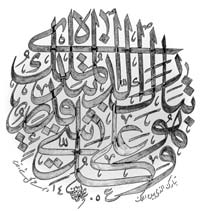
Nothing political here, folks. Just one culture reaching out to another. (I have copied the calligraphy example above hoping that the meaning isn't controversial. When I see Chinese characters used to decorate shirt fabrics or napkins I also wonder what they might be saying.)

Best post headline today!

Ann Althouse...

Dr. Bob's faith

Dr. Bob's Christian response to a skeptic (I'm being polite here) is a study in charity.

Reader advisory: If you aim to follow this post you will have to do a lot of reading. If you read last month's link to Dr. Bob's blog you will be ahead, but a rather long comment thread was generated by that post, including a nay-sayer whose evangelical need to challenge the faith of others prompts what I can only describe as a model of Christian charity to a pagan.

***********
*********
******
***
*
Change directions.
(Or as they say in programming: CD/: )
.
Dr. Bob is also an incredible cook. I have cooked enough turkeys and studied enough chemistry of cooking to know that if you follow his advice about cooking a turkey next year, you will serve up a meal that will be remembered for years to come. Complete with step-by-step pictures.
.
I love his comments.
.
***I have a preference for fresh-killed turkeys over frozen–their water and fat content is lower (avoid pre-basted turkeys at all costs: the all-too-common Butterball is an abomination, if you must know, literally dripping with hydrogenated vegetable oil, the worst kind of fat).
***The gas-or-electric dispute approaches a religious war in some circles; electric is easier to regulate temperature-wise in my mind–and besides, that’s what I have. Oh, and no foil tents–tin foil is ideal for conspiratorial hats and the like, but terrible for roasting, stewing the meat instead of roasting it.
***...and yes–your eyes aren’t lying–apple slices. I use a crisp, moderately sweet apple (Fujis here in the Northwest). During roasting, the apples disintegrate, adding both sugars for caramelization and lots of liquid for the gravy stock.
***...and place lots of butter and a hefty sprinkling of pepper and tarragon. (If you’re on a low-fat diet, this is not the meal for you; for the rest of us, that’s why God created Lipitor).
.
Yep, this is my kind of doctor.

Saturday, December 03, 2005

Melvin Laird -- Iraq: Learning the Lessons of Vietnam

Today I am reading. Eleven pages printed out.
No scanning.
Paying attention, thinking, remembering, reflecting, agreeing and disagreeing.
Melvin Laird is a voice from the past speaking in the present. I didn't like what he stood for when he was Secretary of Defense, but that was a long time ago. We are both about thirty-five years older, neither of us is dead yet and I have the quaint idea that we both might have something constructive to say about current events. I have observed, working in a retirement community, that vanity can be one of the satisfactions of old age. The older I get, the more I relish the notion.

His essay is in Foreign Affairs.

Others who were not there may differ with this description. But they have been misinformed by more than 30 years of spin about the Vietnam War. The resulting legacy of that misinformation has left the United States timorous about war, deeply averse to intervening in even a just cause, and dubious of its ability to get out of a war once it is in one. All one need whisper is "another Vietnam," and palms begin to sweat. I have kept silent for those 30 years because I never believed that the old guard should meddle in the business of new administrations, especially during a time of war. But the renewed vilification of our role in Vietnam in light of the war in Iraq has prompted me to speak out.
[...]
I acknowledge and respect the raw emotions of those who fought in Vietnam, those who lost loved ones, and those who protested, and I also respect the sacrifice of those who died following orders of people such as myself, half a world away. Those raw emotions are once again being felt as our young men and women die in Iraq and Afghanistan. I cannot speak for the dead or the angry. [ed. That's a great sentence.]My voice is that of a policymaker, one who once decided which causes were worth fighting for, how long the fight should last, and when it was time to go home. The president, as our commander-in-chief, has the overall responsibility for making these life-or-death decisions, in consultation with Congress. The secretary of defense must be supportive of those decisions, or else he must leave.
[...]
Donald Rumsfeld has been my friend for more than 40 years. Gerald Ford and I went to Evanston to support him in his first congressional race, and I urged President Bush to appoint him secretary of defense. But his overconfident and self assured style on every issue, while initially endearing him to the media, did not play well with Congress during his first term. My friends in Congress tell me Rumsfeld has modified his style of late, wisely becoming more collegial. Several secretaries during my service on the Appropriations Committee, running all the way from the tenure of Charlie Wilson to that of Clark Clifford, made the mistake of thinking they must appear much smarter than the elected officials to whom they reported. It doesn't always work.


Okay, he's able to offer constructive criticism of Donald Rumsfield. He has my attention. His writing is clear. I'm off to the sofa. See you later.

Report:
There were a few interruptions but the essay is really quick and easy reading. No real surprises, and even after thirty-five years neither of us has changed a lot. Mr. Laird was Richard Nixon's Secretary of Defense and started his term with a pretty clear mandate to get America out of Vietnam. That, more than anything else, was the message Nixon's election over George McGovern.

Laird's objective was to get US forces out while at the same time applying pressure on the South Vietnamese to take make up for the difference, a goal easier said than done. His contention is that had the South been able to receive the same economic support as the North they would not have been overrun two years after the US withdrawal. He blames the Congress for not appropriating enough money to that end.

These points stuck out to me:

***[South Vietnamese President Nguyen Van Thieu] wanted more U.S. soldiers, as did almost everyone in the U.S. chain of command, from the chair of the Joint Chiefs of Staff on down. For each round of troop withdrawals from Vietnam, the Joint Chiefs suggested a miserly number based on what they thought they still needed to win the war. I bumped those numbers up, always in counsel with General Creighton Abrams, then the commander of U.S. forces in Vietnam. Even Nixon, who had promised to end the war, accepted each troop-withdrawal request from me grudgingly. It took four years to bring home half a million troops. He understood what the others did not: that the American people's patience for the war had worn thin.

Bush is not laboring under similar handicaps in his military. His commanders share his goal of letting Iraq take care of itself as soon as its fledgling democracy is ready. And for the moment, there is still patience at home for a commonsensical, phased drawdown. In fact, the voices expressing the most patience about a sensible withdrawal and the most support for the progress of Iraqi soldiers are coming from within the U.S. military. These people are also the most eager to see the mission succeed and the most willing to see it through to the end.

***In this business of trust, President Bush got off to a bad start. Nixon had the same problem. Both the Vietnam War and the Iraq war were launched based on intelligence failures and possibly outright deception. The issue was much more egregious in the case of Vietnam, where the intelligence lapses were born of our failure to understand what motivated Ho Chi Minh in the 1950s. Had we understood the depth of his nationalism, we might have been able to derail his communism early on.

The infamous pretext for leaping headlong into the Vietnam War was the Gulf of Tonkin incident. My old destroyer, the U.S.S. Maddox, was patrolling the Gulf of Tonkin 25 miles off the coast of North Vietnam on August 2, 1964, when it was attacked by three North Vietnamese torpedo boats. That solitary attack would have been written off as an aberration, but two days later the U.S.S. Maddox, joined then by the U.S.S. Turner Joy, reported that it was under attack again. From all I was able to determine when I read the dispatches five years later as secretary of defense, there was no second attack. There was confusion, hysteria, and miscommunication on a dark night. President Johnson and Defense Secretary McNamara either dissembled or misinterpreted the faulty intelligence, and McNamara hotfooted it over to Capitol Hill with a declaration that was short of war but that resulted in a war anyway.

***His west Texas cowboy approach -- shoot first and answer questions later, or do the job first and let the results speak for themselves -- is not working. With his propensity to wrap up a package and present it as a fait accompli, Bush declared, "Mission accomplished!" at the end of the major combat phase of the Iraq war. That was a well-earned high-five for the military, but it soon became obvious that the mission had only just begun.

***Those who call the new Iraqi government Washington's "puppet" don't know what a real puppet government is. The Iraqis are as eager to be on their own as we are to have them succeed. In Vietnam, an American, Ambassador Philip Habib, wrote the constitution in 1967. Elections were choreographed by the United States to empower corrupt, selfish men who were no more than dictators in the garb of statesmen.

***The president must articulate a simple message and mission. Just as the spread of communism was very real in the 1960s, so the spread of radical fundamentalist Islam is very real today. It was a creeping fear until September 11, 2001, when it showed itself capable of threatening us. Iraq was a logical place to fight back, with its secular government and modern infrastructure and a populace that was ready to overthrow its dictator. Our troops are not fighting there only to preserve the right of Iraqis to vote. They are fighting to preserve modern culture, Western democracy, the global economy, and all else that is threatened by the spread of barbarism in the name of religion. That is the message and the mission. It is not politically correct, nor is it comforting. But it is the truth, and sometimes the truth needs good marketing.

Condoleezza Rice is one person in the administration who understands and has consistently and clearly stated this message. When she was national security adviser, the media seemed determined to sideline her repeated theme, perhaps because she was perceived as a mere water bearer for the president. As secretary of state, she is in a better position to speak independently. The administration should do its best to keep the microphone in her hands.

***Vietnam, however, should be a cautionary tale when fighting guerrilla style, whether it be in the streets or in the jungle. Back then, frightened and untrained U.S. troops were ill equipped to govern their baser instincts and fears. Countless innocent civilians were killed in the indiscriminate hunt for Vietcong among the South Vietnamese peasantry. Some of the worst historical memories of the Vietnam War stem from those atrocities. Our volunteer troops in Iraq are better trained and supervised, yet the potential remains for a slaughter of innocents. Reports have already surfaced of skittish American soldiers shooting Iraqi civilians in acts that can only be attributed to poor training and discipline.

To stop abuses and mistakes by the rank and file, whether in the prisons or on the streets, heads must roll at much higher levels than they have thus far. I well remember the unexpected public support for Lieutenant William Calley, accused in the massacre of civilians in the village of My Lai. The massacre did not occur on my watch, but Calley's trial did, and Americans flooded the White House with letters of protest when it appeared that Calley would be the scapegoat while his superiors walked free. The best way to keep foot soldiers honest is to make sure their commanders know that they themselves will be held responsible for any breach of honor.

For me, the alleged prison scandals reported to have occurred in Iraq, in Afghanistan, and at Guantánamo Bay have been a disturbing reminder of the mistreatment of our own POWs by North Vietnam. The conditions in our current prison camps are nowhere near as horrific as they were at the "Hanoi Hilton," but that is no reason to pat ourselves on the back. The minute we begin to deport prisoners to other nations where they can legally be tortured, when we hold people without charges or trial, when we move prisoners around to avoid the prying inspections of the Red Cross, when prisoners die inexplicably on our watch, we are on a slippery slope toward the inhumanity that we deplore. In Vietnam, I made sure we always took the high ground with regard to the treatment of enemy prisoners. I opened our prison camps wide to international inspectors, so that we could demand the same from Hanoi. In Iraq, there are no American POWs being held in camps by the insurgents. There are only murder victims whose decapitated bodies are left for us to find. But that does not give us license to be brutal in return.

***In all, 2.8 million Americans served in and around Vietnam during the war, yet less than ten percent of them were in-line infantry units, the men we think of as our Vietnam veterans. Men were drafted and given a few weeks of training before being attached to a unit of strangers. With few exceptions, our all-volunteer military in Iraq is motivated, well trained, well equipped, and in cohesive units. This is not to say that any of these troops want to be there. They don't. Yet they are far more motivated to fight this war than were the average conscripts in Vietnam.

They are also part of a much smarter military, thanks in large part to the lessons of Vietnam. In 1986, the Goldwater-Nichols Department of Defense Reorganization Act, with input from some veterans of my team at the Pentagon, cleaned up many of the command problems that hindered us in Vietnam and for a decade thereafter. The old system encouraged the Joint Chiefs of Staff to be anything but joint. They protected their fiefdoms and withheld cooperation from one another. The Goldwater-Nichols act centralized authority in the chair of the Joint Chiefs as the primary adviser to the president and the secretary of defense. The separate services are now responsible for training their people for war, but the area commanders who run the wars control all the assets. Today's soldiers, sailors, and air personnel can also be more secure knowing that the people who make life-or-death decisions represent a better balance between military expertise and the will of the people as expressed through their elected officials.

He makes a good case for the all-volunteer army. I was fortunate to have been assigned to Korea instead of Vietnam. My tour of duty was a cakewalk compared with those who went to Vietnam. I'm sure that had I been put into combat my views would not have remained as luxuriously idealistic as they have.

And he sure likes Condoleeza Rice. Doesn't everybody?

Friday, December 02, 2005

Israel training Kurds

Is this an example of Sunnis and Jews preparing to gang up on Shiites?
Let's hope not.

Dozens of former Israeli commandos have been training Kurdish security forces in northern Iraq, supplying them with equipment worth millions of dollars, Yedioth Aharonot newspaper reported Thursday, December 1.

Over the past 18 months, these ex-commandos, who were sent to Iraq by several Israeli corporations, have been training special security units as part of a program organized by the Kurdish authorities, said Israel's top-selling daily.

Operating from a secret desert stronghold dubbed Code Z, the ex-Israeli soldiers, all with elite-unit experience, have been training the Kurds in weapons, self-defense and anti-terror techniques.
[More]


Tip to Nur al-Cubicle
*** *** *** ***
Can't help nit-picking a little. The article has this sentence: A shroud of secrecy has been imposed on the project for fear the Israelis could be targeted by Iraqi resistance groups.
Apparently the writer doesn't know yet that the word "resistance" is no longer politically correct. Too imprecise.

Egyptian election followup

Yeah, I know. What's important about Egypt?
Plenty.
If the US expects that the sacrifices of more than two thousand of our military is to have meaning in the much-advertised fight for democracy in the region, then elections -- however misshapen they may be -- are the pulse of that dynamic. When the word "democracy" is used, our most important allies, Jordan and Saudi Arabia, ain't seriously on the list. Egypt is getting there. When and if the results are in for the region, I don't think most Americans will want to hear the vox populi of the Middle East.

My post about the election shows my own meager background.

Yesterday, Mark Lynch, The Aardvark weighed in.

Hopes for a democratic domino effect, where televised images of voting Egyptians inspire other Arabs to demand the same, are long gone. Al-Jazeera and even al-Hurra (which benefits from a talented Egyptian correspondent) have shown the regime's depradations in such graphic detail that few Arabs will come away inspired. Predictably, the Egyptian regime has respnded by arresting the al-Jazeera team, and Issandr el-Amrani notes that al-Jazeera appears to be jammed in Egypt right now, perhaps because they are showing riots in Mansoura. This isn't the first time -

Reuters reports that a number of journalists are getting arrested and roughed up for their coverage. And here's the kicker: the Bush administration did belatedly, and rather meekly, complain about the violence and call on the Egyptian regime to keep the elections honest. And the Egyptians simply ignored it. So much for American
credibility.


He also liked Baheyya's observations.

Looks like the picture of voters climbing makeshift ladders to vote will mark this historical event. Too bad. I liked the one I posted better, but it is too derivative of the Tienanmen Square image to take first place.

Winding down, I hope...

But at what price?

Pullout, repsitioning, drawing down...call it by whatever name you want. It seems we can finally see the light at the end of the tunnel.

I was just revisiting those heady days in February after the elections in Iraq, imagining how different the last year would have been if the process now becoming clear had been started then instead of now. Looking back, that may have been something like a high point in this murderous adventure. The History Channel is already putting together documentaries about the war.

Battlecry Iraq: Ramadi.
Airs on Tuesday, December 13 at 9:00pm ET

"Today we are going to kill Americans." That was the warning to shopkeepers in Ramadi's marketplace on April 6, 2004. Insurgents meant what they said. They intended to harm any and all members of Echo Company--part of the Second Battalion of the 4th Marine Regiment. Ramadi, a Sunni stronghold and former Saddam power base in the Anbar province, is one of the most dangerous places in Iraq. Resistance there is fierce. "The Magnificent Bastards" as the 2-4 is called, bore the brunt of hatred and rage as they were ambushed in a well-planned attack. We chronicle the 2-4's struggle for survival while under fire--everywhere and all at once--from an enemy that couldn't be seen. AK-47s, machine guns, and rocket-propelled grenades exploded all around. About 50 insurgents positioned themselves on the roofs of one-story buildings and in between market stalls. The next week-and-a-half would be bloody and deadly. TVPG V

And this!!!

Iraq's Most Wanted.
Airs on Tuesday, December 13 at 10:00pm ET

They're cold-blooded killers, not particularly selective about their victims--coalition troops, international journalists, Iraqi civilians--just about anyone will do. These slaughterers want political power. In the south, militant cleric Muqtada al-Sadr unleashes his militia on US Marines policing Najaf. The two forces battle hand-to-hand in a 1,000-year-old cemetery. In central Iraq, a skilled insurgent mortar team tries to disrupt national elections by targeting polling places in and around Fallujah. Marine Recon squads quietly hunt them down and kill them one-by-one. In the northern city of Mosul, Uday and Qusay Hussein, sons of Saddam, help plan and fund insurgent training and operations. US Special Forces and 101st Airborne troops surround their hardened, reinforced hideout and decimate it. For Iraq's "Most Wanted", the message is clear: surrender and you might live; resist and you'll crumble in a storm of lead. TVPG V

As you follow the next few posts, look for the name/word "Sadr" again.
Maybe I'm missing something, but it looks like to me the same people we were trying to wipe out before are now providing security for what now passes for a legitimate government in Iraq. The effect is surreal.

...there is widespread evidence that an increasing number of members of the Mahdi Army, led by the hot-headed Shiite cleric Muqtada al-Sadr, and Badr Organization are joining the ranks of Iraq’s military and engaging in paramilitary-style policing methods. “The ISF is not a true national force but rather a carved-up conglomeration of militias,” says Kenneth Katzman, senior Middle East analyst with the Congressional Research Service. The latest evidence: The November 13 discovery of a detention center in Baghdad allegedly run by Iraqi intelligence officials linked to the Badr Organization, where eighteen of the center’s roughly 170 captives—most of them Sunni Arabs—were reportedly beaten, blindfolded, or subjected to electric shocks. [Link to Council of Foreign Relations]

The spinning of a betrayal is dizzying. (A more charitable take: They say that if people really are out to get you it isn't paranoia. By the same logic, if you don't know or care what you're doing, it isn't betrayal.)

The same fountain of terrorism that US forces targeted as "the enemy" is now furnishing the Badr Brigades that provide the underpinning of the Iraqi Security Forces. The next few posts expand upon this theme. The prestidigitation of a Las Vegas magician is nothing compared with the sleight of hand displayed by Washington politicians.

"...winning back hearts an minds in America may be as challenging as it has proved in Iraq."

Enter the Council on Foreign Relations.
Ever heard of that? A time or two, maybe?

Faced with a chorus of demands to lay out an “exit strategy” for Iraq, President Bush countered with a condition: “complete victory.” This enraged his critics—for instance, the New York Times’ lead editorial Thursday is headed, “Plan: We Win.” Yet his Naval Academy speech, for the first time, set forth some conditions that might trigger the beginnings of a draw down and gave details in a a 35-page report on how U.S. forces plan to get there. Both the speech and the strategy document amount to a “watershed moment” in the Iraq debate, says CFR’s Lee Feinstein in an interview with cfr.org’s Bernard Gwertzman.

The speech emboldened supporters of his Iraq policies, including CFR Fellow Max Boot, who bemoaned “
White Flag Democrats.” The Wall Street Journal seconded his motion. Still, less partisan voices, including military experts interviewed in this CFR Background Q&A, point out winning the domestic debate is not the same thing as shoring up support in Congress. Iraq’s unpredictable Shiite militias are a major variable, according to this CFR Background Q&A. Lawmakers on both sides know, as Washington Post political columnist Daniel Froomkim points out, there is a crucial midterm U.S. election coming. Nor is there evidence yet the president’s words have swayed an increasingly skeptical public. Early returns, provided by this CNN poll,
suggest that winning back hearts an minds in America may be as challenging as it has proved in Iraq.

I'm not vain enough to imagine anything I have to add will have any meaning here.
Most readers are clever enough to read and grasp what this says.

Thursday, December 01, 2005

Is there Civil War in Iraq?

From the Council on Foreign Relations.
These are just snips. More at the site.

Michael O’Hanlon (NO) The kind of civil war I’m worried about is of the ethnic-cleansing kind, where people form militias and clear out neighborhoods. Nothing close to this kind of situation is happening in Iraq now.

Kenneth Katzman (Maybe/Probably) This week it’s definitely become clearer that we’ve entered civil war, but whether it’s a sustained or permanent feature, we don’t know.

Marina Ottaway (Strictly speaking, No) To go from acts of terrorism to civil war you need two population groups deliberately targeting each other. As long as it is insurgents trying to kill people to dissemminate terror, and the population is angry at the terrorists, that does not constitute civil war.

David Phillips (Yes) It’s already civil war. Civil war is sectarian-based conflict that’s systematic and coordinated. This has been going on for some time [in Iraq]. I’d say the bombing in Najaf in the months after Saddam’s statue was toppled [in April, 2003] was the opening salvo.

Thomas X. Hammes, US Marine Corps (Not yet) I think you know it when you see it, but we’re not there yet. In a true civil war, the mass of society on both sides is involved. Civil war would require family-on-family violence. That’s not the case yet.

Steven Metz (Probably, sooner or later) I’ve said all along the chances are perhaps fifty-fifty that the ultimate outcome [in Iraq] will be some sort of major civil war. I haven’t seen anything politically or militarily that would lead me to change that position.


I report.
You decide.
* * * * * * * * * *
Followup...
I was checking my links and found that the David L. Phillips link doesn't do like the others to identify the man. Maybe his views have made him persona non grata at the old think tank.

I did find this:

Constitution Process Risks a Civil War
Author: David L. Phillips

August 26, 2005Newsday

President George W. Bush called the drafting of Iraq's constitution an "amazing event." But instead of fostering consensus, the process has actually increased chances for civil war.

The constitution pits Islamists against secularists, Shia against Sunnis, Arabs against Kurds, and women against men. The "new Iraq" is a far cry from what President Bush had in mind when he promised freedom to the Iraqi people.

In 2003, the United States thought it could simply decapitate Saddam Hussein's Ba'athist regime and easily establish a liberal democracy in the heart of the Arab world. Since then, the Bush administration has continually lowered expectations. Today it is embracing a constitution that lays the groundwork for theocratic rule. The constitution also is undemocratic and out of step with human rights norms.


[More at the link]

Know what you are supporting

My guess is that if you mentioned Badr Brigade or Wolf Brigade to most people they would have no idea what you were talking about. If US policy is to support and defend what passes for legitimate government in Iraq, then a clear understanding of how that government works is in order.

This from The Council on Foreign Relations website:

There is a growing chorus of complaints from Sunni Arab leaders that the Iraqi Security Forces (ISF) has been infiltrated by Shiite militias that engage in torture, kidnappings, and, in some cases, deaths squads against Sunnis. Though Iraq’s leadership downplays these outbreaks of violence, experts say there is widespread evidence that an increasing number of members of the Mahdi Army, led by the hot-headed Shiite cleric Muqtada al-Sadr, and Badr Organization are joining the ranks of Iraq’s military and engaging in paramilitary-style policing methods.
[...]

These militias have put the U.S. government in a difficult bind: On one hand, experts say, these groups are effective in fighting the Sunni-led insurgency. Last year, the U.S. military fought alongside militia groups in counterinsurgency operations in Mosul and Samarra. On the other hand, these groups are fueling sectarian tensions and infiltrating the military, which raises doubts as to where these soldiers’ allegiance lies.
But U.S. officials seem unworried by the spread of militias. “They are increasingly an Iraqi problem, not a U.S.problem,” says a senior Defense Department official who preferred not to be named. Though Iraqi militias were technically banned by the
Coalition Provisional Authority (CPA) in June 2004, the U.S. military is “encouraging existing militias into the security services—that is true,” says the Defense Department official. “We continue to examine their loyalties but also are trying to build loyalty [to the Iraqi state].”
[...]
The Badr Organization, formerly known as the Badr Brigade, was built by Iraqi Shiite defectors and soldiers captured by Iran during the 1980-1988 Iran-Iraq War. Its members were funded, trained, and equipped by the Iranian Revolutionary Guard Corps. In 2003, the 10,000-strong militia changed its name from the Badr Brigade to the Badr Organization of Reconstruction and Development after pledging to disarm and devote itself to peaceful purposes and is now the armed wing of the Supreme Council for the Islamic Revolution in Iraq (SCIRI), a Shiite opposition party founded in 1982 by Iraqi exiles in Iran. SCIRI, which has emerged as Iraq’s most powerful political party, advocates the creation of a separate, Shiite-run region comprising nine oil-rich provinces in southern Iraq. In a rare November 27 interview with the Washington Post, SCIRI’s leader, Abdul Aziz Hakim, downplayed his organization’s ties to Iran and denied accusations that the Badr Organization practiced torture or targeted Sunni Arabs.
[...]
One of the Badr Organization’s offshoots is the Wolf Brigade, a unit of roughly 2,000 special commando police officially under the Ministry of the Interior that is among Iraq’s most feared groups. Last November, the brigade—which was formed in the fall of 2004 by a former three-star Shiite general and SCIRI official whose nom de guerre is Abu Walid—fought alongside U.S.-led forces in Mosul, a Sunni stronghold northwest of Baghdad. Its members dress in garb—olive uniform, red beret, wraparound sunglasses—redolent of Saddam’s elite guard; their armband logo is a menacing-looking wolf. Last December, the Wolf Brigade won further notoriety after the success of Terrorism in the Grip of Justice, a primetime show on U.S.-funded al-Iraqiya television that featured live interrogations of Iraqi insurgents by Wolf Brigade commandos. In one show, Abu Walid questioned around thirty shabbily dressed suspects, some clutching photos of their victims, waiting to confess their crimes.

Folks, there is a lot more going on than is being discussed openly. I don't think The Council on Foreign Relations is a collection from the lunatic fringe. There is a lot to be learned there that decent Americans need to read and study. There are numerous references to torture and other methods of intimidation, not by the "enemy" but on the part of those we are officially training and defending. These are not nice people.

Abu Khaleel in yesterday's post presents what US policy looks like from the Iraqi point of view:

The declared objective is to have a sufficient number of US-trained Iraqi forces to do the job. But what forces? The same forces that have been committing atrocities that are worse than those committed by those infamous bad American apples? The same forces infested and infiltrated by sectarian pro-Iran militias, crooks, thugs and criminals that have been causing havoc in the country, abducting people and arresting then killing them for a variety of known and unknown reasons?

What will that achieve? Only more sectarian strife, more lawlessness and more chaos. And in the unlikely event that they will succeed, we will only have an obnoxious police state.That policy would be as subtle and as ‘thoughtful’ as the bygone policy of winning the hearts and minds of people while humiliating, torturing and killing them and devastating their country. It has about the same chances of success.

It doesn’t make sense… unless, of course, the objective remains to “bomb the living daylight out of them”.

I notice that the President's recent speech distinguished among three categories of Iraqis in a clumsy effort to identify one of those three groups as the ones we are fighting. Also the word "insurgent" is now politically incorrect, replaced with some new phrase or other. (Even Donald Sensing had fun with “enemies of the legitimate Iraqi government” instead of insurgent. His wonderful comment: Ah, that adds clarity.) I can't decide if I am more embarrassed or angry that after three years policy wonks have not done a better job of discernment for the president.

Clearly we cannot discern among the many groups that make up the Iraqi population. I don't know how many there are, but there are a lot more than three. This is a very poor taxonomy to decide whether or not we are supposed to be killing people. And outsourcing the job to thugs is not the best way to create good public relations.

We are not on the side of many angels in Iraq. Our intentions may be good, but our connections are badly out of synch with our ideals. The Badr Brigade and its wicked offspring-- our official allies, incidentally -- do not make the US look any better in the eyes of everyday people there.

To steal a line from Lincoln, you can intimidate all of the people some of the time, or some of the people all of the time, but...well, you know how it goes.

Two quickies for your reading enjoyment

Both from Richard Lawrence Cohen. First, a string of haiku. Here is one of seven.

From the neighbor’s yard
hammering nails into wood
sounds like, “Leave your home.”

Next, a tale of acorns...
From the comment thread, a good comment:

Oh, for the days of having acorn collections.

Oh, for the days of being able to send kids out to play by themselves (not that feasible in my L.A. neighborhood).

There's something so moving to me about Agent 97 calling you out to look his collection. THAT is childhood at its best, blissfully free of video games and other manufactured stuff. I want to find more opportunities with my daughter to loll around in our natural surroundings (even though we don't have many deciduous trees).

Yet another look at bird flu

Bird flu reading is making me tired. I want to say Let's get on with it and get this pandemic on the road. The speculation among experts is as tedious as a 200-item blog comment thread.
Tyler Cowen is trustworthy. (I think he's one of the Volokh conspirators; check the sidebar for CV) He points to this report from the American Enterprise Institute worth reading.

Since pandemic planning has become the rage, most organizations involved have adopted their pet disease model to help guide their preparedness and response decision-making processes. The biggest problem is that few of these models are any good. Some of them mistakenly lead policymakers into believing that it will be possible to contain an outbreak of pandemic influenza through
the use of antiviral medications and vaccines delivered to those identified at risk by epidemiological contact tracing and geographical location.[5] What is not immediately obvious to the algebraically challenged is that in order for the outbreak to be “ringed,” or contained, half of all first-generation infections need to be identifiedwithin the first twenty-four to thirty-six hours of transmission. Anyone with clinical experience knows that it is impossible to do this--in any health care setting in the developed world, let alone the developing world.
[...]
As a result of nearly a century of technological development since the 1918 pandemic, surveillance and response capacity is now fairly good in some countries. The world no longer needs to wait for all health assistance to come from the United States or Western Europe. The ability to identify and treat disease now flows from regional fonts of expertise. That is not to say that international cooperation will not be necessary in a future pandemic; it will just be easier to implement by interfacing with regional medical and health centers.

Lots of good stuff here. Quick reading, but still time-consuming.
Everyone's time is precious, so I guess print it off, take it to the loo, and leave it for somebody else when you're through.

Recommended reading: M. Simon

Power and Control is the evocative name of a blog I read, M. Simon, blogmaster. He's another guy in his sixties who has an avocational dedication to the subject of drug use as related to PTSD. He comes by his positions with a long, focused and disinterested look at the issues. This most recent post is a good summary of his work.

Is addiction real? A very interesting question.

I think there is an answer to that question. Obviously I think the answer is not in the affirmative. Why? Well there in lies a tale.

For me it started with Dr. Lonnie Shavelson. In July of 2001 I read a review of his book "Hooked" and learned some things. One of the things I learned was that in his sample of female heroin users 70% were sexually molested before they started heroin use. He also found that male heroin users were 25 to 50 times more likely to have been sexually abused than the general population. I wrote an article on the subject.
Heroin. What I suggested in that article was that a large number of heroin users were taking the drug for relief from severe PTSD.

The next piece of the puzzle came to me in November of 2002 when I read
this report done on the CB1 receptor in mice. A cannabinoid receptor also found in human brains. The report showed that fear memories which seem to be mediated by the CB1 receptors decay at different rates depending on genetics. I wrote this review of that report: Addiction or Self Medication? What I figured out from the report is that the reason drugs are addictive (long term use) for some and not others was based on
genetics. A very big key to the puzzle of addiction. In the past the fact that some get addicted and others do not was ascribed to the "addictive personality". Now no one could tell you what an addictive personality was. It couldn't be defined. So in fact it was mumbo jumbo. I now had another piece of the puzzle. However twin studies showed that genetics only accounted for 50% of the cause for addiction. What was the other 50%? Pretty obvious from Dr. Shavelson's report. Trauma.

Not everyone will admit that they are interested in this subject. But whenever I get to know anyone personally and share with them that we have a family member with a severe substance abuse issue, they all -- and I mean ALL -- relate, because they also have a family member with a similar problem. This is a subject that crosses all social and economic lines but remains in the closet because of social stigma attached to talking about it openly.

Mr. Simon has done his homework. He has important contributions to make to what passes for a public debate shrouded by political positioning and individual denial.

Wednesday, November 30, 2005

Col. Ted Westhusing -- Why and how did he die?

I have questions.
A few days ago I linked to a video reportedly depicting random shooting of civilian targets in Iraq.
At the time I posed a cynical question: How long (in hours) will it be before talk show hosts figure a way to marginalize the story, attack the messenger(s) and/or justify what the video is depicting?
I have been watching and waiting now for three days and the story seems to have sunk from sight. My link to KOS now has a followup link to an article in the LA Times regarding the apparent suicide of one Col Ted Westhusing. The common denominator is "private contractors in Iraq.
The death of Col. Westhusing is being investigated.
The story seems to have just started.

Westhusing, 44, was no ordinary officer. He was one of the Army's leading scholars of military ethics, a full professor at West Point who volunteered to serve in Iraq to be able to better teach his students. He had a doctorate in philosophy; his dissertation was an extended meditation on the meaning of honor.

So it was only natural that Westhusing acted when he learned of possible corruption by U.S. contractors in Iraq. A few weeks before he died, Westhusing received an anonymous complaint that a private security company he oversaw had cheated the U.S. government and committed human rights violations. Westhusing confronted the contractor and reported the concerns to superiors, who launched an investigation.

In e-mails to his family, Westhusing seemed especially upset by one conclusion he had reached: that traditional military values such as duty, honor and country had been replaced by profit motives in Iraq, where the U.S. had come to rely heavily on contractors for jobs once done by the military.

His death stunned all who knew him. Colleagues and commanders wondered whether they had missed signs of depression. He had been losing weight and not sleeping well. But only a day before his death, Westhusing won praise from a senior officer for his progress in training Iraqi police.

His friends and family struggle with the idea that Westhusing could have killed himself. He was a loving father and husband and a devout Catholic. He was an extraordinary intellect and had mastered ancient Greek and Italian. He had less than a month before his return home. It seemed impossible that anything could crush the spirit of a man with such a powerful sense of right and wrong.


There is something wrong with this picture. Very wrong.

I have seen other reports of "straight as an arrow" career military types associated with other stories that do not exactly, shall we say, support the official spin that policy-makers or commanders would have them present. But I don't recall anyone ranked as high as Colonel among them. (There may have been a General or two, but at that level I start to think in terms of political ambitions beyond military careers so arguments about policy take on a different implication.)

A lot of media reporters are "embedded" with the military, which turns out to have been a good thing over all. But I don't know how many media types are embedded with the private sector over there. My guess is that there are very few. And the few that may be there might well be in-bed-with rather than embedded with their host entity. I just don't know.

But this I can be sure of: Wars may be about principles, but the dearest principle driving the war in Iraq is the profit motive. Why else do private outfits compete for contracts? Why else do former men and women uniform return in a civilian capacity? How else do we have a "volunteer" army?
Altruism and a desire to have a warm feeling because they are doing good work?
Riiiight.
If that is so, maybe we should renew the Peace Corps and send in a bunch of real volunteers.

It's the economy, stupid. That's what I call stuck on stupid.

The death of Col. Westhusing is a tragedy whether it was a suicide or a homicide. Either way he is a casualty of the war that occurred as the result of the corruption of private contractors paid for by US tax dollars.

Monday, November 28, 2005

"...a civil-military divide has emerged in the United States over the war in Iraq."

Michael O'Hanlon in today's Washington Post points out a sharp and widening difference of opinion about the US adventure in Iraq. Military types are looking through rose-colored glasses, and a growing number of civilian types are growing more gloomy. The writer says both sides of the debate need to be checked.

...military leaders...point to some good news on the economic front: growing gross domestic product, bustle on the streets, creation of small businesses, adequate availability of most household fuels, gradually improving national infrastructure for water and sewage, more children in school, more Internet usage, and lots more telephone service. They also note the gradual improvement in Iraqi security forces, with 30,000 or more now capable of largely independent operations. And they rightly observe the remarkable progress made in drafting the Iraqi constitution. A can-do military officer aware of such information, and also tactically succeeding day in and day out in finding and killing insurgents, is likely to see a trajectory toward victory.

But is that really what is happening? Growing GDP is good for those with access to the twin golden rivers flowing through Iraq -- not the Tigris and Euphrates, but oil revenue and foreign aid. The rest of the economy is, on the whole, weak. Unemployment remains in the 30 to 40 percent range, and the psychologically most critical type of infrastructure -- electricity -- has barely improved since Saddam Hussein fell. Iraqi security forces are getting better, but they are also losing more than 200 men a month to the insurgency. Civilian casualties in Iraq from the war are as high as ever; combine that with the region's highest crime rates, and Iraq has clearly become a much more violent society since Hussein fell. Tactically, the resistance appears to be outmaneuvering the best military in the world in its use of improvised explosive devices. And politically, every move forward toward greater Sunni Arab participation in the political process seems to be accompanied by at least one step back.


Solid observations. Too bad the public is so polarized that neither side wants to contemplate the less dramatic but more realistic view of this writer.
Open-minded readers are urged to read the whole thing.
There won't be much attention paid because the writer is not extreme enough. Too bad. The blogosphere, reflecting the public at large, is getting to be like the evening news: if it bleeds, it leads.

Warrior children

Stanley Crouch points out that children have historically been trained as warriors because

...they possess very malleable minds and have not had enough of the life experience necessary to perceive a clear moral relationship to other people. The revolutionary doctrine or the traditional tribal animus or the religious rhetoric will suffice to corrupt them.

Any reading of history will show the truth of this assessment. I noticed some time ago that most wars are started by adults but fought by children. I know that eighteen or twenty is no longer "childhood." But I have met very few people over fifty who think of twenty-two year olds as peers. Even the Constitution has higher age requirements for becoming president.

Jimmie Briggs has written a book called "Innocents Lost: When Child Soldiers Go To War," which gives us a contemporary update on the cruelest form of child abuse. That is what we need to realize about the use of children to do the dirtiest of dirty work, the torturing and killing of people. This has become common to tribal wars, rebel units, religious fanatics and totalitarian regimes. It is estimated that 10% of the world's fighting forces are under 18.
[...]
This is an important book because it underlines the universal fact that ours is a time in which our perhaps naive sense of childhood innocence is under assault in both the advanced and developing world. The young are exploited either by the popular entertainment that dehumanizes, fills them with terrible appetites, encourages irresponsible behavior, or promotes, like rap, the hatred of women.

That exploitation, however, is no more than the result of decadence, greed, moral ambiguity and indifference, all propelled by the power of profit.

In "Innocents Lost," Briggs reveals to us the power that is sought through the use of children to dominate or destroy others. Yes, this is the worst form of child abuse. So Briggs makes one unwavering fact clear to those of us who don't know: Humanity is not something you are born with, it is a feeling for life that is passed on to you by your culture and is always the responsibility of adults.


It bears repeating: ...always the responsibility of adults. It is for this reason that reports of prison abuse, random shooting of civilians, swapping war pictures for porn, and the rest of the moral lapses deriving from this war in Iraq are so serious. It's not enough to dismiss any of these behaviors as the antics of a few bad apples or a handful of unprincipled adults. Absent clear signals at the command and policy levels these actions become as much a part of our national image as terrorism becomes part of the image of Islam without clear denunciations on the part of those who know better. If these behaviors are not clearly denounced, they become part of our culture. That is why clear official policies forbidding torture are so important.

Yes, I know the book is not about our young people. Heavens, no! It is about savages and other third-world primitives who still haven't learned to pull up their socks. I can anticipate objections to this post along those lines. To people who think like that I don't expect to be persuasive. I can only point out that I have seen a lot of people in my life, both primitive and sophisticated. And I can report having seen both tenderness and savagery among both. Not to mention a serious number of people who seem to make it through life never having left childhood at all.

Looks like I may have to order this book. Somebody else seems to be connecting the dots.
Thanks to Booker Rising for the link.

Egyptian democracy

If the Egyptian version is a touchstone for democracy in rest of the Middle East, the US is on the wrong side of history.

This essay by Baheyya is worth a look. I come away from her analysis with two important conclusions: First, the forces that control Egypt are very unpopular -- so much so that the official policy about voting is to prevent as many potential voters as possible from exercising their right to vote. Second, a group known as the Muslim Brotherhood, or Ikhwan, is perhaps the strongest opposition voice in the country.

You don't want to know what the Muslim Brotherhood stands for. As far as I can determine, they are the Egyptian counterparts to Pat Robertson, Michael Savage and a vigilante border patrol group all rolled into one. You also don't want to know how very popular they are.

The Ikhwan have done well to take voters and their needs seriously, and voters in turn are returning the favour by braving security phalanxes and demanding their right to be heard (above). Now I am deeply ambivalent about the Ikhwan, but who cares? As my Egyptian politics guru rightly reminds (that’s right, guru), one cannot impugn their fundamental respect for the ordinary Egyptian, and their superior skills at capitalising on and augmenting seemingly puny opportunities. They are not infallible and they are not without schisms, but they are committed. And they are clean.

So before the pundits begin to produce their post-mortems, moaning and wailing about the supposedly sinister rise of the Ikhwan, let’s be honest and clear-headed here. The Egyptian public is not some drugged mass following the siren song of religion. The Egyptian public is suffering from a regime that is aloof and inept at the very best and dangerous and violent the rest of the time. It is not a mystery nor a ‘problem’ how an uncorrupt, moralising, problem-solving, and politically astute organisation has captured the provisional trust of large swathes of that public. The challenge for the Ikhwan as a political phenomenon will be to maintain and truly live up to voters’ trust. No easy task, and not a foregone conclusion.
Our anaylist is clearly not on the side of this group. But despite her personal views she can see the obvious: the group is undeniably popular. This picture reminds me of that famous image of the lone student in Tienanmen Square facing a line of tanks. As Baheyya notes, "There is something deeply noble to me about this lone citizen trying to negotiate her way into this formidably fortified Alexandria polling station."

Sunday, November 27, 2005

"...security guards in Baghdad randomly shooting Iraqi civilians..."

It's late Sunday as the story breaks.

Question: How long (in hours) will it be before talk show hosts figure a way to marginalize the story, attack the messenger(s) and/or justify what the video is depicting?

LINK........LINK........LINK........LINK

Fewer hearts and minds to worry about, I suppose.

* * * * *

Tuesday, November 29

I was wrong. The video "doesn't have legs," as they say in the news business. Maybe it isn't bloody enough. Or specific enough. Or maybe people just don't want to listen to Elvis any more. I dunno. Anyway, it's still on the charts at blogsnow.

Michael Yon to the big screen

Those of us who have been reading Michael Yon can anticipate the movie version, thanks to Bruce Willis. I can't think of a better advocate.

ANGERED by negative portrayals of the conflict in Iraq, Bruce Willis, the Hollywood star, is to make a pro-war film in which American soldiers will be depicted as brave fighters for freedom and democracy.

It will be based on the exploits of the heavily decorated members of Deuce Four, the 1st Battalion, 24th Infantry, which has spent the past year battling insurgents in the northern Iraqi town of Mosul.

Willis attended Deuce Four’s homecoming ball this month in Seattle, Washington, where the soldiers are on leave, along with Stephen Eads, the producer of Armageddon and The Sixth Sense.

The 50-year-old actor said that he was in talks about a film of “these guys who do what they are asked to for very little money to defend and fight for what they consider to be freedom”.

Unlike many Hollywood stars Willis supports the war and recently offered a $1m (about £583,000) bounty for the capture of any of Al-Qaeda’s most wanted leaders such as Osama Bin Laden, Ayman Al-Zawahiri or Abu Musab al- Zarqawi, its commander in Iraq. Willis visited the war zone with his rock and blues band, the Accelerators, in 2003.

“I am baffled to understand why the things I saw happening in Iraq are not being reported,” he told MSNBC, the American news channel. He is expected to base the film on the writings of the independent blogger Michael Yon, a former special forces
green beret who was embedded with Deuce Four and sent regular dispatches about
their heroics.

Yon was at the soldiers’ ball with Willis, who got to know him through his internet war reports on www.michaelyon.blogspot.com. “What he is doing is something the American media and maybe the world media isn’t doing,” the actor said, “and that’s telling the truth about what’s happening in the war in Iraq.” [More from the Times of London]


Also from those of us who also no longer read newspapers, thanks Josh Claybourn for the notice.

Panama Canal video

Readers using dial-up will have to excuse me. I am finding more and more multimedia links that catch my fancy.
This one is a time-lapse piece that shows a week in the life of the Panama Canal compressed into eleven minutes. It's not the kind of thing you are apt to come across on television. And if you did it wouldn't be easy to go back and watch it again.
Found at BoingBoing.

Saturday, November 26, 2005

Sobering look at H5N1

How a virus can morph into a killer...

From MSNBC, reporting the last of a three-part series.
In the last of a three-part series, LiveScience examines how a virus jumps from birds to humans and reaches pandemic proportions.

Other pandemics

In addition to the 1918 flu, there have been two other pandemic outbreaks — defined as spreading around the world within a year of being detected — in the last century. The "Asian flu" H2N2 was detected in China in February 1957. By June of that year it had spread to the United States, causing about 70,000 deaths. In early 1968 the "Hong Kong flu" H3N2 was detected in Hong Kong and spread to the United States later that year, causing 34,000 deaths.

The H3N2 virus is still in circulation today and is included in this year's flu vaccine.

Both of these started in Asia and, like the 1918 flu, contained a combination of human and avian influenza virus.
[...]

Shifty genes

Influenza could become a pandemic threat because its genetic information is constantly shifting. The virus can change two ways -- the common and subtle "antigenic drift" and the rare but drastic "antigenic shift."

Antigenic drift refers to the continuous changes in the virus that make it slightly different than previous versions, requiring the yearly production of new vaccines. While your immune system may have developed resistance to previous versions of the H1N1 virus, for example, it can't prevent infection against this year's slightly newer version.

Antigenic shift is a major reshuffling of proteins in the virus that results in a new subtype combination of neuraminidase and hemagglutinin surface proteins, in science-speak. If this new subtype has never been seen in humans, or hasn't been seen in many years, most people won't have protection when it enters the population.
[...]

Vaccine must wait

Because the avian virus has yet to mutate to the point where it spreads easily among humans, scientists do not know exactly what characteristics to include in a vaccine. However, a study testing the immune response of the outer portion of an inactivated avian H5 strain in people older than 65 recently got under way. The vaccine is similar to the regular flu vaccine, but targeted to the avian type.
[...]

Signs of resistance

Making matters worse, the avian flu has shown signs of resistance to Tamiflu, an antiviral drug that treats the symptoms of the flu and also helps prevent infection in healthy people. It had been thought that the drug could be used to slow the spread of the avian flu until a vaccine is developed, which could take anywhere from six months to a year or more.


This last part is disturbing. Most of what I have been reading has put a lot of stock into the Tamiflu-as-weapon meme.
Read the whole article and follow the links if you want to stay up to date. Good information and education is the best defense.

Middle of the night reading

Not now. Later.
Bookmark this post by Richard Lawrence Cohen and come back at a more quiet time to digest it. A very humbling Thanksgiving offering. If more people had this degree of inner understanding wars could end.

Then read the comments thread.

If my parents had been in any kind of harmony I probably would have gone crazy early in life, but because they were constantly warring I always had at least two viewpoints to choose from, and any hurtful thing one of them said was contradicted by the other. By steering among the contradictions I found space to become a third force in the family, unifying my younger brothers alongside me in a spirit of desperate mockery of the powers above us.

Then see what Ann Althouse said.

This is not the first time these two formerly married people have revealed a degree of empathy for one another that most mortals never know, even in their dreams.

Friday, November 25, 2005

Comment on "Islamofascism"

Here's a good rule of thumb: If you come across the phrase "Islamo-fascist" unironically deployed in an article, there's a 99-percent chance the author doesn't know what he or she is talking about.


This post is a personal bookmark. When and if my archives are ever read I want this sentence to be found among the debris. This nelogism has found its way to common currency in printed and broadcast media and is well on the way to becoming part of everyday spoken English. The effect is as poisonous as lazy N-word, Gook or Jewish conspiracy, all of which I have heard used casually and with no sense of irony. (I can't put my finger on it at the moment, but a few weeks back I came to the conclusion that Islamophobia has become the New Anti-semitism. The more I think about it, the more I am convinced it is so.)

Thanks to Tim Cavanaugh for pointing it out.
And thanks to Matthew Hogan for catching it.

Later...

Found it. Link to my other post.

No, eating turkey doesn't make you sleepy

It's a myth. (See also Snopes)

There's reportedly good Thanksgiving news for turkey lovers: Contrary to popular belief, tryptophan in turkey doesn't cause drowsiness.

In fact, scientists told National Geographic News the substance could possibly aid in the treatment of depression and multiple sclerosis.

Purified tryptophan is a mild sleep-inducing agent and that probably led to the idea that foods containing heavy doses of the chemical cause drowsiness. But tryptophan can't function well as part of a meal.

"Tryptophan is taken to the brain by an active transport system shared by a number of other amino acids and there's competition among them -- like a crowd of people trying to get through a revolving door," Simon Young, a neurochemist at McGill University in Montreal, Canada, told National Geographic News.

He said consuming tryptophan-rich foods may cause blood levels of the amino acid to rise, but not enough tryptophan will reach one's brain to have a sedative affect. And, scientists told NGN, turkey isn't even unusually high in tryptophan. Many other foods, such as beef or soybeans, have higher concentrations.

And while we're on the subject of turkeys, here's a link to a wonderful thread of comments illustrating that turkeys can engage in navel-gazing just like people...
The turkey that laid a golden egg

Thursday, November 24, 2005

Jake says "Thanks"

Remember the contest? Thanks to everyone's support Jake won the contest!
Jake thanks you, I thank you, Jake's Momma thanks you, Mollie thanks you, everyone thanks you. Small pleasures can be great fun!

Here is a picture of Jake and Mollie admiring the prize for winning the contest, a photolithograph made from the winning image.

And here is another shot of Jake striking the same pose. Like I said, what's not to love about a face like that?

The world's ugliest dog is dead

No, this is not about anyone in Washington, although we might find a few runners-up inside the beltway. This is really a dog of a dog. I feel a bit left out since he is already known by a lot of people, has a couple of websites and has appeared in cinema. Via blogsnow, here's a link. Be sure to see the CNN video. At first I wanted to post a picture, but after seeing the video I knew that no still image could do justice to this critter.

(Hope everyone had a good Turkey Day. Ours was good because it was hosted by one of the next generation. And speaking of dogs, there were three or four dogs there, including a three-legged pug. Lost a leg to cancer at nine years old. I shoulda been a vet.)

Alice's Restaurant

No, we don't really believe that we can get anything we want at Alice's Restaurant, excepting Alice. But it takes us back to a time when we believed we might get anything we wanted, even though we wanted the world, and we wanted it now!. Everyone we knew really could imagine fifty people a day walking into the draft board, singin' a bar of Alice's Restaurant and walking out, creating the Alice's Restaurant Anti-Massacre Movement. And all we had to do was sing along the next time it came around on the guitar.

That's what Ira Chernus, Professor of Religious Studies at the University of Colorado at Boulder, says about Arlo Guthrie's timeless classic Alice's Restaurant. I listened to the record enough that I have most of it committed to memory. There was also a movie, which included footage of Woodie Guthrie himself but I don't think the real Officer Obie had a part.

There was a time when I imagined that my children would be able to hear my stories of the Sixties and be enthralled but I got over it. Years ago when video rentals first started I was delighted to bring home The Yellow Submarine, knowing how much fun the kids would have with the music and seeing those marvelous graphics of Peter Max. I waited until we could see the film together, anticipating the fun we share across the generations.

Well that isn't what happened. After about twenty minutes they got bored and went into the kitchen to start something else, leaving Dad out there in the family room to watch his old movie. The magic was not there. The excitement was to be mine and mine alone, and any story-telling from me was like those walking-home-from-school-for-miles-in-the-snow stories I had heard from my parents. Sigh... So much for teaching anything to the next generation. Thankfully I have been somehow able to teach some more important basic values. All our kids give us much of which my wife and I can be proud, but make no mistake about it. Their's is its own generation. And the best I hope to garner from them about accounts of my own wonderful development is patient tolerance, transparently tired but polite.

My peers and younger readers with time and curiosity, then, can now link to A Thanksgiving Ritual for '60s-Style Activists, the back to the Thanksgiving post at Talk Left, which talks about the annual ritual on radio station KBCO radio station at noon to hear the 25 minute version of Arlo Guthrie's Alice's Restaurant. I have to be at work today, so I will have to rely on my memories, but as long as they remain clear, I won't need the radio. I still have the record, of course, but we no longer have a record player. Sigh...